

Building Mastery: Amani Tre Niner – COVER STORY
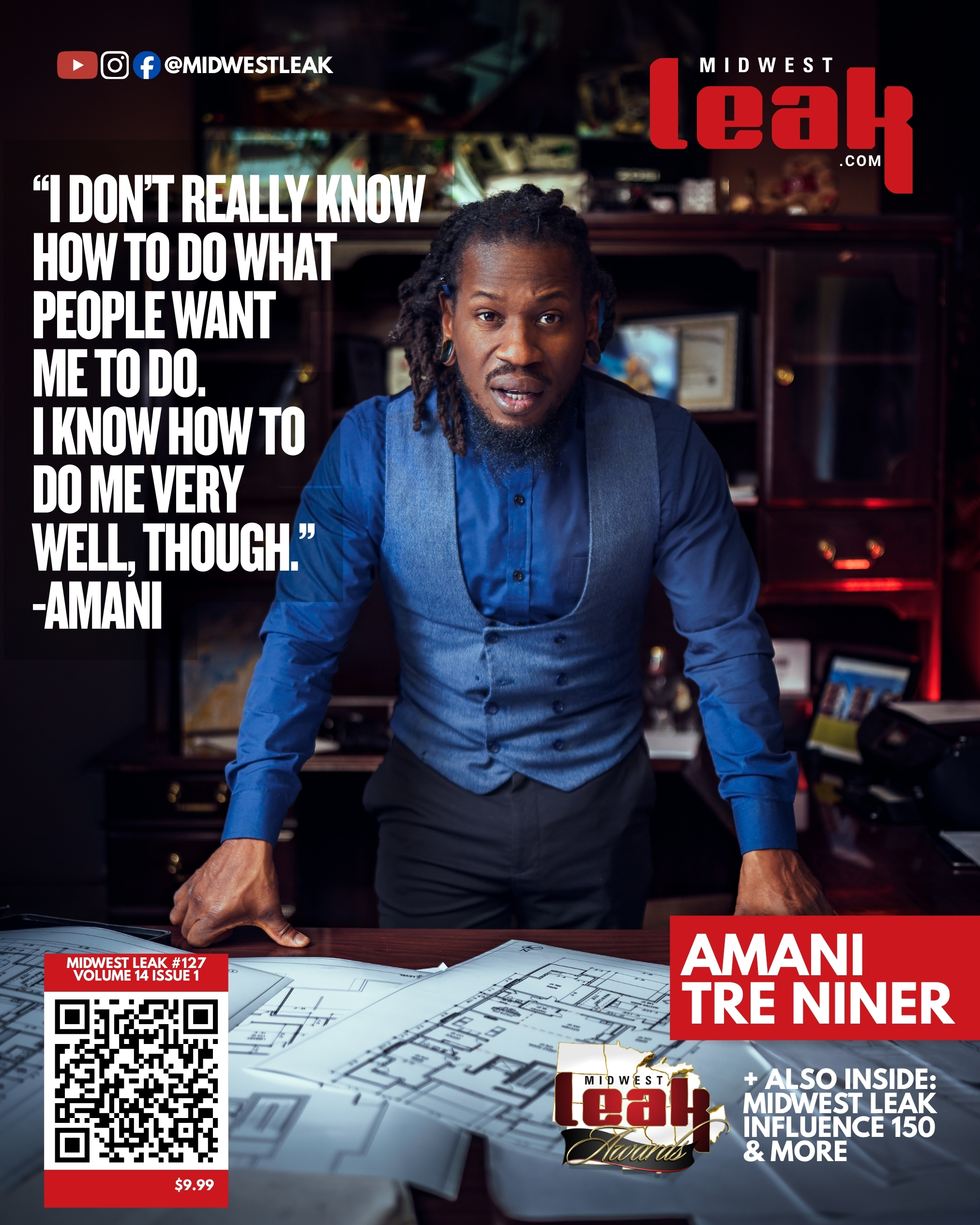
Amani Tre Niner: Eenbody Can Get It
Written by Le’Deana Brown
Photography by Tristian David Simpson / Oneeighty Tristian
Midwest Leak Magazine | Cover Story
Amani Tre Niner does not do anything casually. Not a portrait tattoo, not a sixteen-bar verse, not a classic car stripped to its frame, not a two-bedroom house he plans to make four bedrooms bigger. Whatever he touches, expect it to return transformed.
For decades, Amani’s influence has expanded through every form his art has taken and every person his work has reached. Across skin, music, automobiles, fashion, and real estate, he continues building toward the same goal: mastery in every discipline he approaches.
Building Mastery
Amani began as a portrait artist, working in graphite before he added paint, canvas and digital art to his vocabulary. Drawing became so natural that he sometimes woke up with a pencil still tucked behind his ear. Art was already living inside his daily habits long before it became a profession. He is self-taught…a path that forced him to learn through repetition, observation and error, and that same understanding now shapes the way he teaches.
Tattooing in his signature style requires fluency in color theory, opacity, translucency, light trajectory and other technical artistic skills and elements that he learned from the ground up.
His confidence can sound like confrontation to anyone unfamiliar with the work behind it. But the certainty comes from years of discipline and an unusually wide range. Art requires full presence. Participation without transformation has little value. Mastery, in his world, is the ability to understand a discipline deeply enough to leave a signature on it.
“If you draw a triangle, it’s a triangle,” explains Amani. “If I draw a triangle, it’s Geo-Man!”
This approach to his art also appears in his approach to music. He refuses to enter a song as a decorative guest. If he agrees to contribute, he studies the key, pace, production and energy, then rebuilds the portion around his voice. The same discipline governing his visual art follows him into the recording booth.
“I don’t think I’m better at anything than rapping,” he says. “I got the voice that you can smell it. You can smell that pot bubbling when I’m rapping.”
That philosophy helped establish him as one of Indianapolis’ and the nation’s most recognized tattoo artists and also most elusive turning down opportunities to appear on major television platforms because the structure required him to surrender too much creative control. Some could say that insistence has cost him opportunities. It has also protected the quality people associate with his name.
Amani has never been comfortable performing a version of himself designed by someone else. “I don’t really know how to do what people want me to do,” he says. “I know how to do me very well, though.”
He views money as a result of meaningful work rather than the reason to accept it.
“Don’t ever do nothing for money that you wouldn’t already do for free,” he says. “Otherwise you selling yourself, and that’s a freaky lane.”
His language is direct because his boundaries are direct. He will travel, collaborate, appear or contribute when the work aligns with what he values. He has little interest in occupying spaces solely because they offer visibility.
Before social media gave the word “influencer” its meaning, he had already built an audience through music, art and personal relationships. Those supporters became clients. More than that, they became a community.
He can often predict which pieces of content will travel. He also understands the value of sharing work that may receive less immediate attention. A viral moment may introduce someone to his page. The rest of the work gives them a reason to stay.
Building Art in Motion
Amani’s catchphrase, “Eenbody can get it,” became part of the culture around him. His audio has been remixed, reenacted and adapted across the internet. He does not chase virality. Virality arrived as a result of his authenticity. People see something in Amani that feels difficult to manufacture: confidence without permission and a perspective that remains consistent whether a camera is present or not.
Amani’s relationship with cars began long before his tattoo career.
At 17, he entered the automotive business through his uncle and opened the first business of his own. He has never held a traditional job in his adult life. Entrepreneurship became the structure through which he explored everything else.
Cars eventually became another form of art.
The restored classics he builds are designed to carry the appeal of their original bodies while offering the performance, technology and comfort of a modern car. He studies power first, then practicality, then beauty.
That order reveals his creative discipline. Design carries greater meaning when every component serves a purpose.
His builds may include new drivetrains, computers, updated suspension, LED screens, digital controls and modern technology inside antique bodies. The goal is to create a vehicle that feels as reliable and comfortable as the owner’s daily car while retaining the personality that made the classic worth restoring.
From tattooing to automobile restoration, each requires him to envision the completed piece before the parts have been assembled.
That idea gives “Eenbody can get it” another layer. Skin can get the work. A classic body can get the work. A song can get the work. A property can get the work. Anything he touches becomes an opportunity to apply discipline, imagination and an expectation of transformation.
“I like to create things where there was nothing before.”
Amani’s retirement from tattooing redirects his attention toward new disciplines and bigger canvases.
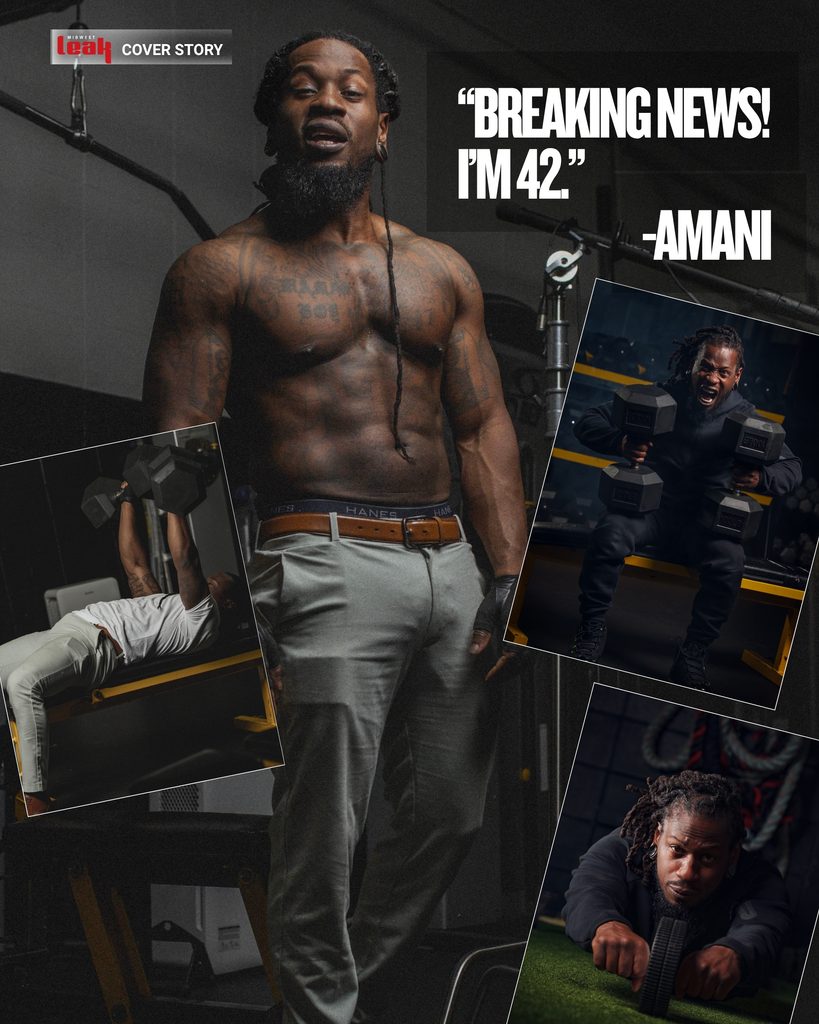
He officially began tattooing on September 24, 2009. For much of the following fifteen years, he worked seven days a week and could remain at the chair for as many as 18 hours. By the end of 2024, he had largely stepped away from taking regular clients, continuing only occasional work for longtime customers and demonstrations for apprentices.
He is leaving the industry with the same confidence he brought to entering it. He believes his presence set a benchmark, and that stepping back gives emerging artists room to establish new prices, new styles and new standards without comparison to him.
His perception carries ego because mastery requires enough belief to face a blank canvas and assume something exceptional can be created. It also carries an awareness of the larger ecosystem. An artist’s influence should eventually create room for others to rise.
Building Possibility
Retirement gives him time for the lanes that demand his direct attention. Real estate is one of them. He develops residential and commercial property from concept through construction. His latest piece is a two-bedroom, one-bath home he is turning into a four-bedroom, three-bath property with a five-car garage.
Yes, this is excessive. The excess is the point.
He builds because creation gives him energy. Blueprints allow Amani to look beyond what currently exists. A vacant lot, exposed frame or unfinished room holds the same promise as a blank sheet of paper or tattoo-less skin. Each one is an invitation to imagine structure, scale and possibility.
He owns and develops properties without making ownership central to his public identity. The work satisfies him even when the audience never learns his name is attached.
The builder studies what is missing, develops the skill or team required to create it and moves forward even when there is no guarantee that the public will recognize the labor.
Fashion will become another discipline to study, shape and master. Lifelong learning gives Amani access to the creative freedom he values most. Retirement allows him to decide what deserves his energy without the pressure to remain attached to the things he’s already known for.
He calls that freedom the ability to build what interests him until another challenge becomes more compelling.
“I’m just building,” he says. “And when I get tired of building that, I’ll build something else.”
Building Legacy
Amani estimates that more than 160 artists have come through his apprenticeships.
Some have appeared on television, worked in studios across the country, and trained artists of their own, creating branches of a lineage that began inside Animation Art Studio.
“I want to do for people what wasn’t done for me,” he says.
His disappointment comes from seeing artists benefit from apprenticeship without extending that opportunity to others. He believes learning creates a responsibility to teach. He also believes the story of how an artist developed matters.
When artists erase the people and places that contributed to their growth, younger creatives may assume their heroes reached mastery alone. That illusion can make emerging artists feel inadequate when their own progress requires instruction, correction and community.
Animation Art Studio was created to become a home for artists, rather than a destination centered entirely on him. It is a living entity and a community where artists collaborate, debate, support and share ideas. That is the culture he wanted to build.
The studio can operate without Amani’s constant presence because he built it to outlive his daily labor. His legacy also lives beyond the studio walls.
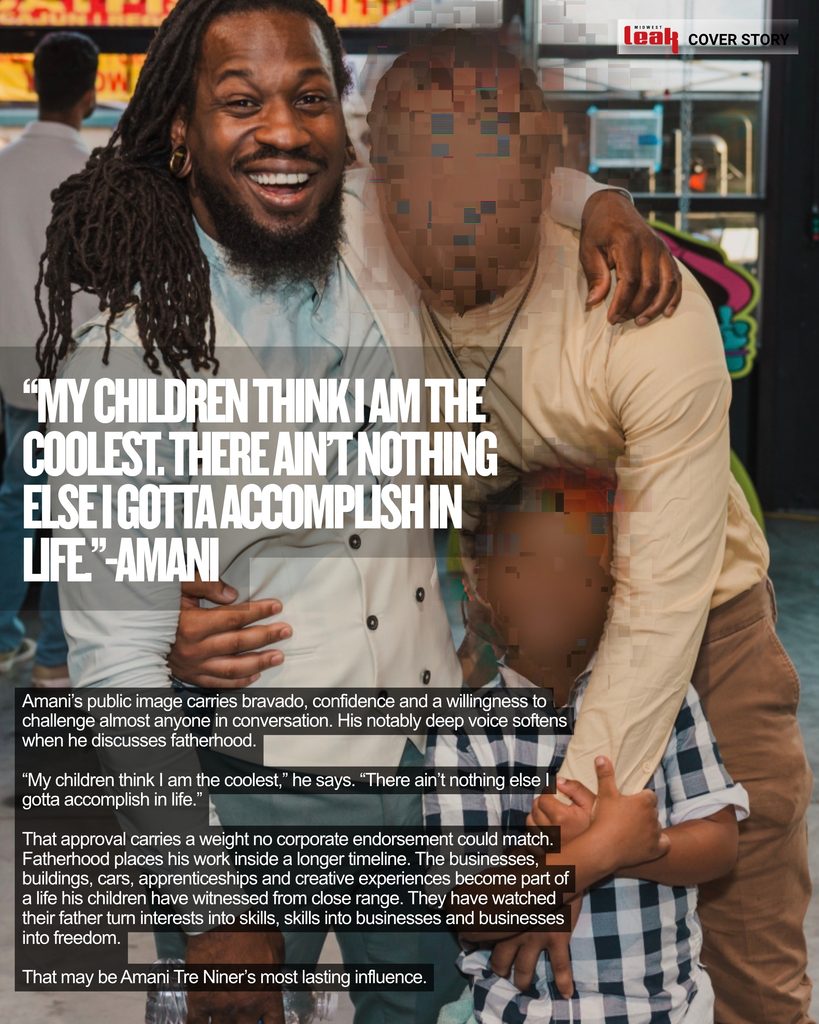
“My children think I am the coolest. There ain’t nothing else I gotta accomplish in life.”
Amani’s public image carries bravado, confidence and a willingness to challenge almost anyone in conversation. His notably deep voice softens when he discusses fatherhood.
“My children think I am the coolest,” he says. “There ain’t nothing else I gotta accomplish in life.”
That approval carries a weight no corporate endorsement could match. Fatherhood places his work inside a longer timeline. The businesses, buildings, cars, apprenticeships and creative experiences become part of a life his children have witnessed from close range. They have watched their father turn interests into skills, skills into businesses and businesses into freedom.
That may be Amani Tre Niner’s most lasting influence.
Ultimately, Amani demonstrates that mastery can travel.
An artist can study color and later study horsepower. An entrepreneur can build a tattoo studio and later read architectural plans. A rapper can become a developer. A mentor can become a student again. In fact, they can all be occurring on the same timeline.
The body of work continues to expand because Amani has never allowed one success to become the ceiling of his imagination.
“Eenbody can get it” began as a phrase people repeated because of the way he said it. Within the context of his life, it has deeper meaning.
It’s Amani’s creative promise that absolutely anything he touches can be transformed.
Midwest Leak Influence 150
Amani is proof that authenticity can create influence. He never organized his life around becoming popular. His inclusion in the Midwest Leak Influence 150 reflects a reach that has nothing to do with followers or views. It lives in the standards artists adopted after watching him work, the careers built through his apprenticeships, the studios shaped by people he trained, and the creative confidence he carries from one discipline to the next. The canvas may change, but the philosophy does not.


Leave a comment